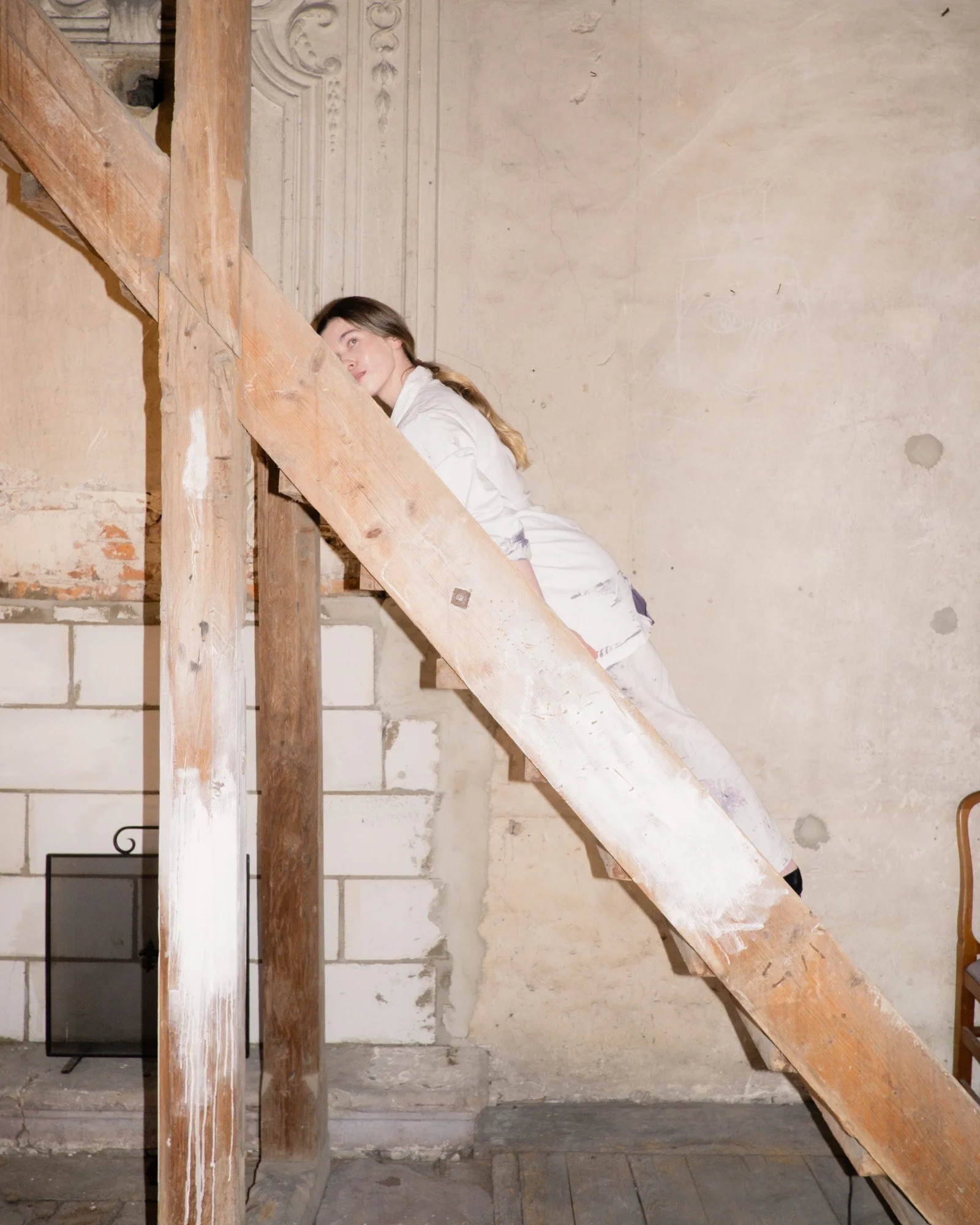
BIOGRAPHY
Anastasia Shivrina (b. 1991, Italy) is a Russian-Canadian artist based in Berlin. With a background spanning more than twenty years in contemporary dance, theatre, and choreography, Shivrina transitioned through film before establishing her painting practice. Her work is rooted in movement, using choreography as a methodology through which she investigates spatial composition, rhythm, materiality, and form. Working with pigment, casein, and marble dust, alongside oil and wax, her practice explores the materialisation of movement and the ways the principles of space, time, and energy can be translated into painting.
ARTIST STATEMENT
My practice is rooted in an ongoing curiosity about what can emerge from the fundamental principles of movement. Drawing on more than twenty years of experience in contemporary dance, theatre, and choreography, followed by work in film and, over the past five years, painting, I approach visual art through a foundation in movement, spatial composition, rhythm, and form.
The three fundamental principles of dance—space, time, and energy—form the basis of this approach. I work with choreography and movement as methodologies, using my body as a vehicle through which these principles are translated into material and visual form. Rather than representing movement, I am interested in its materialisation: how movement can generate form, become embedded within a surface, and remain visible through the traces it leaves behind.
My approach to painting is informed by spatial awareness, rhythm, force, repetition, duration, and the composition of form. Through layering, compression, transfer, removal, and accumulation, movement becomes integral to the construction of the work itself.
Material research is central to this process. My recent work brings together pigment, casein, and marble dust, alongside my ongoing work with oil and wax. I am interested in the different densities and resistances of these materials and in how they respond to movement—how they can retain, obscure, and reveal the actions through which a painting is constructed.
My current research also develops modular painting units through the logic of a choreographic score. Individual works can be shifted, sequenced, and placed into different relationships, allowing composition to operate not only within the painting but between works and within the surrounding space. As in choreography, a change in the position of one element alters the composition as a whole.
Through painting, material experimentation, and spatial composition, I investigate the materialisation of movement and the composition of form—how the principles of space, time, and energy can move from choreography into matter, and how movement itself can become a method for constructing visual form.
SELECTED EXHIBITIONS
2026 — Zwischen Bäumen, Villa Schöningen, Potsdam, in cooperation with PASSAGE.
2026 — After Blue, Before Red, DUVE Berlin × PASSAGE, Berlin.
2025 — Polyphonic Views, Funkhaus Berlin, presented by PASSAGE.