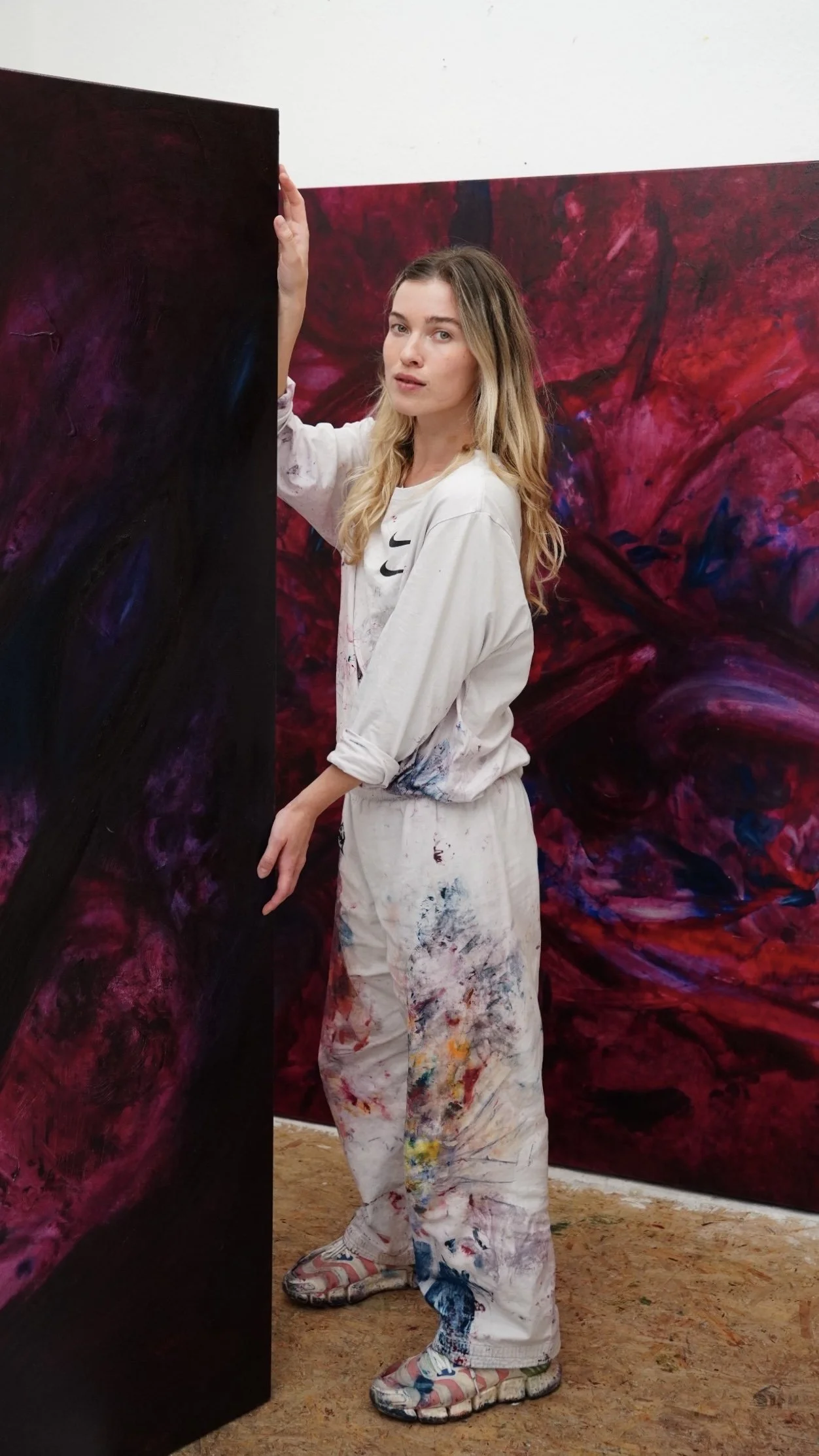
Anastasia Shivrina (b. 1991, Italy) is a Russian-Canadian movement artist and painter whose practice is rooted in choreography and dance as both methodology and conceptual framework. Her work explores the relationship between movement, materiality, memory, and transformation. Drawing on over twenty years of experience in choreography and contemporary performance, she approaches visual art through an understanding of movement, spatial composition, rhythm, and embodied forms of expression. Rather than treating movement as something to be represented, she is interested in how it can be embedded within materials, surfaces, and spatial relationships.
Working primarily in painting while increasingly expanding into modular and spatial forms, Shivrina investigates the ways physical actions leave traces, accumulate histories, and shape perception. Through processes of layering, compression, transfer, accumulation, and transformation, she explores how gesture, duration, resistance, and change become materially visible. Materials are not passive tools within her practice; they possess their own agency, resistance, and capacity for transformation.
Her practice is informed by choreography as a methodology rather than a subject. Concepts such as rhythm, repetition, sequencing, interruption, and spatial composition guide the development of works that exist between image, object, and environment. She is particularly interested in how relationships between individual elements generate meaning through movement, reconfiguration, and exchange.
Recent research focuses on expanding painting beyond the fixed image through the development of modular systems and movable framing structures that function as choreographic units. Similar to a choreographic score, these elements can be shifted, rearranged, and placed into new relationships, allowing movement-based logic to extend from the painted surface into the organization of space itself.
Through painting, material experimentation, and spatial composition, Shivrina's work investigates how movement can be recorded, transformed, and reactivated through form.